Guide · Special orders
Managing bridal special orders from deposit to delivery
A special order is a promise with a date on it. The bride pays a deposit months ahead for a dress that does not exist yet, and everything between the sale and the pickup is invisible to her. The shop's job is to make that stretch boring: the order placed on time, the arrival tracked, the fittings booked before the dress lands, the balance collected without a chase, and nothing discovered the week of the wedding.
At the sale: record more than you think you need
Everything that goes wrong later was unclear at the sale. Before the deposit is taken, the order should state exactly what was bought and when it will be ready.
- The gown: designer or model, size ordered (and the measurements it was chosen on), color, length, any customization (sleeves, neckline, lining), and the sample it was tried in.
- The dates: the wedding, the date the bride needs the dress (earlier), the promised arrival or completion date, and the date alterations must start.
- The money: price, deposit, balance, when the balance is due, and whether alterations are included or quoted separately. Deposits and payment plans covers the policy.
- The agreement: cancellation terms, size changes, who pays for alterations, and a signature. A signed agreement at the sale is the cheapest insurance a shop can buy.
While it is made: one job, one list of stages
Give the order a job number and a list of stages that match how the dress really gets made. For a designer order that is: ordered, confirmed, shipped, arrived, inspected. For a gown made in your own workroom it is your sewing stages: cutting, base, first fitting, beading, second fitting, finishing. The stage is the single source of truth for “where is it?”.
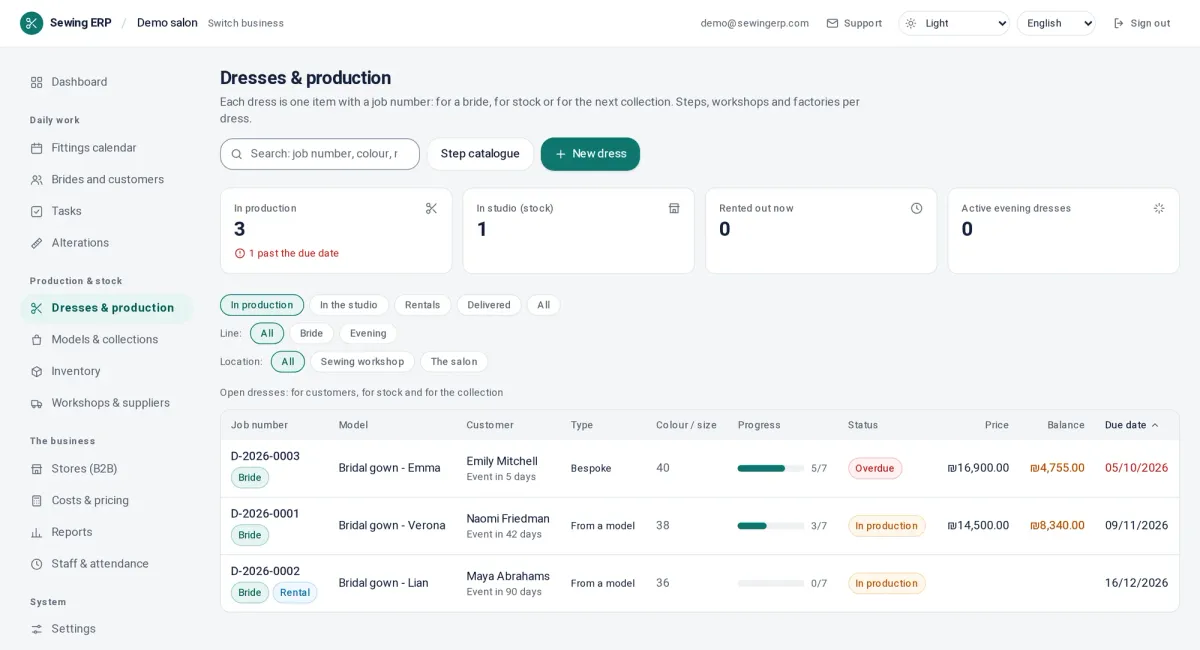
In SewingERP each dress has a job number and your own stage catalog. Stages done in the workroom are reported by the seamstress from her phone, work sent out to an outside workroom becomes a work order with a return date, and materials ordered for the dress are purchase orders with an expected date. All three feed the same list of what is late. Workroom tracking explains the stages and the QR reporting.
The arrival date is the deadline that matters
Brides think the wedding is the deadline. For the shop, the deadline is the arrival: the dress must be in the shop six to eight weeks before the wedding so that fittings and alterations have room. Record the promised date when you place the order, and check a list of orders past that date every week. A dress that is two weeks late is a phone call to the designer; a dress that is two weeks late and nobody noticed is a crisis.
Book the fittings when the order is placed, not when the dress arrives. The fitting timeline shows the dates; the calendar then tells you, months ahead, whether the arrival date leaves enough room.
The balance: collected on a date, not at the door
The balance is easiest to collect when it is attached to a date the bride already has in her diary: the first fitting or the start of alterations. Put the due date on the order, remind her a few days before, and record every payment against the dress so the balance is always one number. A bride who sees her balance in her own portal rarely argues about it at pickup.
SewingERP records deposits, payments and payment plans on the dress, shows the balance on the bride's card and in the bride portal, and can email a reminder before a fitting when there is a balance. It does not process cards: you collect the money with whatever you use today and record it.
Handover: inspect, sign, and close the job
- Inspect on arrival, not at the fitting. Open the box the day it arrives, compare it with the order (size, color, customization) and photograph any fault. The designer's claim window is short.
- The final fitting is the acceptance. The bride sees the finished dress, the balance is settled, and she signs that she accepted it. If something is still to be fixed, write it on the job with a date.
- Close the job. A closed job freezes the price, the payments and what the dress really cost, so the next quote is based on the last one. The costing guide explains the numbers.
Questions
What is a special order in a bridal shop?
A gown that is not taken off the rack: ordered from a designer in the bride's size and color, made to measure in the shop's own workroom, or a shop sample altered heavily enough to count as a new garment. It has a lead time of weeks or months, a deposit, a balance, and usually alterations at the end.
What deposit should a bridal shop take on a special order?
Most shops take 50% at the order and the balance before alterations start or at pickup; some split the balance into a payment plan. The deposit should cover what you cannot recover if the bride cancels: the designer's order or the materials and the cutting. Write it in the agreement and have it signed.
How does SewingERP track a special order?
The order is a dress on the bride's card with a job number, a model, the wedding date and the delivery date. It moves through stages (ordered, arrived, first fitting, alterations, final fitting, delivery, or your own sewing stages if you make it), payments and the balance sit on the same card, and the dashboard shows which orders are late against their delivery date.
How do you avoid a dress arriving too late?
Work backwards from the wedding: the dress must arrive six to eight weeks before, to leave time for two or three fittings and the alterations between them. Record the promised ship date when you order, and have a list of orders past that date that someone checks every week.