Guide · Payments
Bridal deposits and payment plans: setting a policy
A made-to-order gown costs the shop money long before the bride pays for it: the fabric and lace are bought in the first week, outside work is paid when it comes back, and workroom hours go in every week. The deposit and the payment plan exist to keep that money in step with the work, so the shop never finances a dress it has not been paid for.
What is the deposit for?
It pays for what you commit on the bride's behalf. The moment you order lace in her size and color or start cutting, that money cannot be used for anyone else's dress. A deposit that covers those costs means a canceled order is a disappointment, not a loss.
It also confirms the order. Until a deposit is paid, nothing should be ordered and no workroom time should be booked for the dress, however sure the bride sounds.
How do I choose the deposit amount?
Work it out from the dress, not from what other shops charge. List what you will spend before the next payment arrives:
- Materials ordered for this dress: fabric, lace, tulle, lining, beads.
- Outside work you will pay for before the next payment: embroidery, a factory, an outside seamstress.
- Workroom hours until the first fitting, at the cost of the people who do them.
The deposit should cover at least that total. Round it to a percentage of the price that you use for every dress of that kind, so the bride hears one clear rule and the team never negotiates it at the counter. Many shops use one percentage for made-to-order gowns and a smaller one, or payment at the first fitting, for alterations. The costing guide shows how to add up what a gown really costs.
How do I split the rest into a payment plan?
Tie each payment to a point in the work that the bride can see, and put a date on it:
- Deposit when the order is confirmed, before anything is ordered.
- Second payment at the first fitting, when she sees the dress take shape and the biggest costs are behind you.
- Balance at the final fitting or at pickup, and always before the dress leaves the shop.
Write the plan into the agreement with the amounts and the dates, not only the percentages. A bride who knows that the next payment is due on a given date pays it; a bride who was told to pay “during the process” forgets. If a bride asks for more installments, add them between the same points rather than moving the last one past the wedding.
What should the agreement say?
- The price of the dress and what it includes (fittings, alterations, pressing, a bustle), and what costs extra.
- The deposit, whether and when it can be refunded, and what happens to it if the bride cancels.
- Each later payment with its amount and date, and that the dress is handed over only when it is paid in full.
- What happens when the bride's measurements change a lot between fittings, or she asks for design changes after the work started.
- How long the shop keeps a finished dress that has not been picked up.
Ask the bride to sign it at the first appointment. Deposit and cancellation rules depend on the country you work in, so have a local lawyer or accountant check the wording once; then use the same agreement for every bride. For the rest of the record, from the first fitting to pickup, see what to record and have signed.
How do I follow up on a payment that is late?
Check once a week which payments are past their date, and contact the bride the same week, politely and with the amount and the date that was agreed. A late payment two months before the wedding is a conversation; the same balance on the day of pickup is a dispute. Before delivery, send a reminder with the balance still due, so nobody is surprised at the counter.
How does SewingERP help?
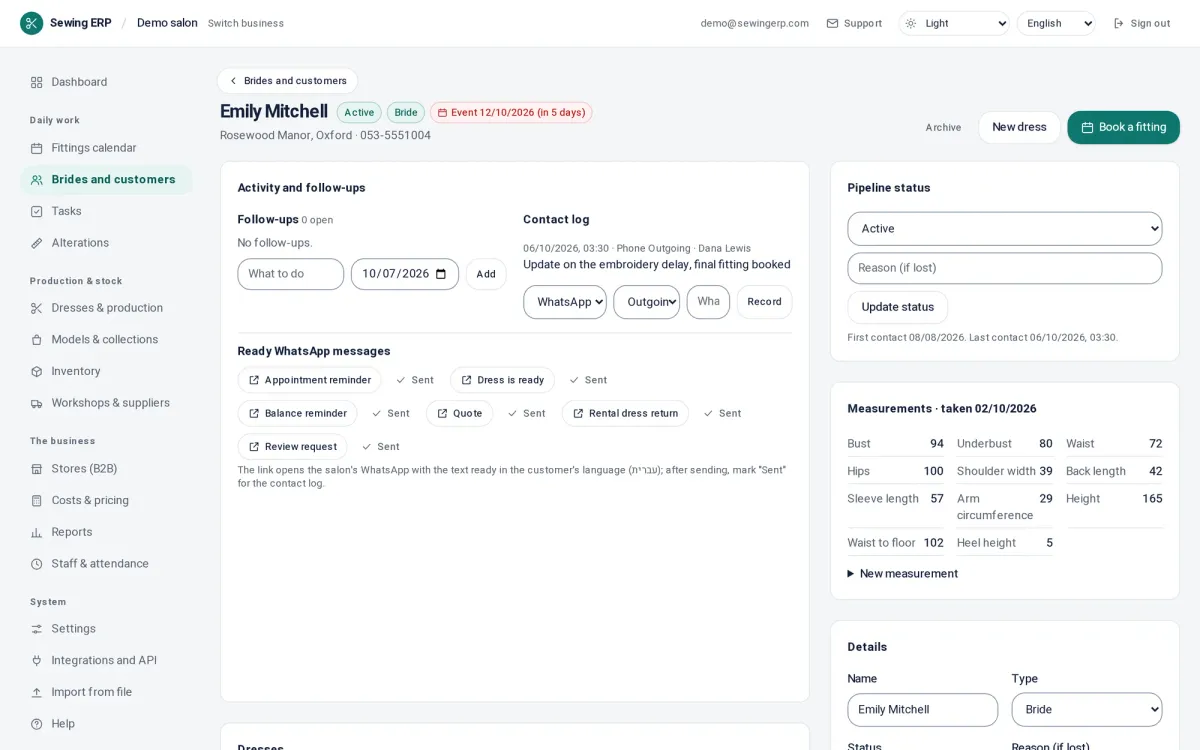
In SewingERP the deposit the shop usually takes is a setting (40% by default), and the close-the-sale step proposes it on the agreed price. Every deposit, payment and refund is recorded on the bride's card with the balance still due. A payment plan has its installments with dates, amounts and method (including checks); an installment past its date is marked late, and overdue installments show up in the dashboard's “What's stuck today” list.
An optional email reminder can go out a few days before delivery when there is still a balance, in your shop's wording. If you turn on the bride portal, she sees what she has paid and what she still owes, never your cost breakdown. SewingERP does not take card payments: it records payments taken by cash, transfer, card terminal or check, and in Israel it can issue the receipt through Morning, iCount or Sumit. An agreement can be signed digitally, on a tablet in the shop or by link.
Questions
How much deposit should a bridal shop take?
Enough to cover what you spend before the next payment is due: the fabric, lace and outside work you order for this dress, plus the first weeks of workroom hours. For a made-to-order gown that is a large share of the price, because most of the money goes out early. For an alteration, where you buy almost nothing, a smaller deposit or payment at the first fitting can be enough.
Should the deposit be refundable?
Say clearly in the agreement what happens to it and when. Many shops make the deposit non-refundable once materials are ordered or work has started, because that money is already spent. Consumer rules on deposits and cancellations differ by country, so check yours before you write the policy; this guide is not legal advice.
Do bridal shops offer payment plans?
Many do, because a gown is a large purchase made months before the wedding. A payment plan works when it has fixed dates and amounts, written down and agreed at the start, and when the last payment is due before the dress is handed over, not after the wedding.
When should the balance be paid?
Before the dress leaves the shop. A common choice is to tie the last payment to the final fitting or to pickup, so the bride knows the date from the first day and the shop never hands over a gown with money still open.