Guide · Software
Bridal shop management software: what to look for
Bridal shop management software keeps every bride, appointment, dress and payment in one place, from the first consultation to pickup. Look for five things: fittings and measurements tied to the wedding date, every dress followed through special order, alterations or the workroom, deposits and payment plans with the balance due, staff who can work from a phone, and a price you can see before you sign up. A POS or a booking app covers only part of that.
What does bridal shop management software do?
It follows the bride rather than the sale. A retail customer buys and leaves; a bride orders months ahead, comes back three or four times, changes size, pays in parts and picks up a week before the wedding. The software keeps that whole story on one card and turns it into today's list: who is coming in, which dress is late, which payment is overdue.
How does it compare with a POS or a booking app?
| Retail POS | Booking app | Bridal shop management software | SewingERP | |
|---|---|---|---|---|
| Built for | The sale at the counter | The calendar | The bride, from consultation to pickup | Bridal shops and ateliers, with or without a workroom |
| Wedding date | Not tracked | Sometimes a note | On every dress, fitting and payment | On every dress, fitting and payment |
| Fittings and appointments | Rarely | Yes, with reminders | Yes, tied to the dress | Calendar with rooms and staff, email reminders, online booking |
| Measurements | No | No | Usually, with history | Every measuring saved as a new version |
| Special orders and alterations | A sale or a note | No | Tracked to a ready date | Job number per dress, your own stages, phone reporting by QR |
| Deposits and payment plans | Partial payments or layaway | Sometimes a booking deposit | On the order, with the balance due | Deposits, installments, overdue list, bride portal |
| Card payments | Yes, its main job | Sometimes online | Varies by product | No: records payments taken on your own terminal |
| Pricing | Monthly, plus card fees | Monthly, often per staff member | Monthly; some per user, some unpublished | $79 to $249 a month, unlimited users |
Many shops end up with two tools: a card terminal or POS to take the money, and management software for everything around it. That works as long as every payment is also recorded against the bride, so her balance is right. What that looks like in practice.
What should I look for?
- The wedding date on everything. Every list, dress and fitting should show how many days are left, and what is late should surface without anyone building the list by hand.
- Fittings with rooms, staff and reminders, and ideally online booking that respects your open hours and the number of fitting rooms.
- Measurements with history, so a change between fittings is visible instead of overwritten.
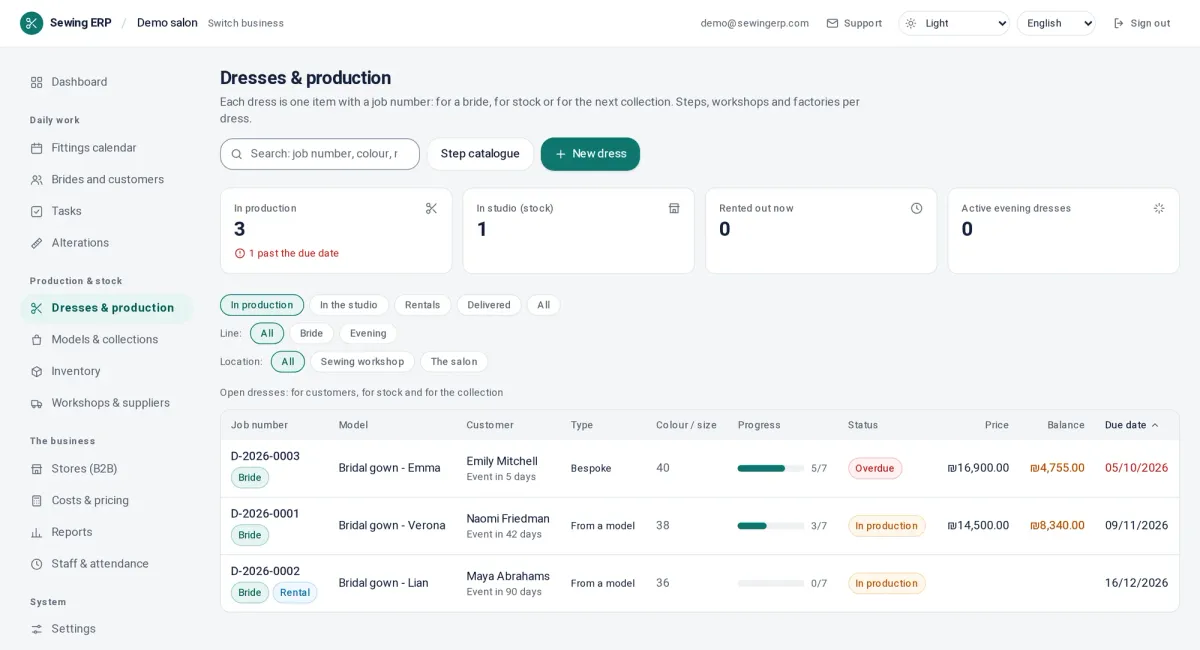
- Every dress tracked to a date: special orders to their arrival, alterations and made-to-order gowns through their stages, outside work until it comes back. How alterations tracking works.
- Money on the order: deposit, payment plan, balance and a reminder before pickup, whether or not the software takes cards itself. Setting a deposit policy.
- Staff, data and price: roles, a phone view for seamstresses, a full export at any time, and a published price that does not grow with every user.
Which questions should I ask every vendor?
- Does it take card payments, or only record them? Which terminals or processors does it work with?
- Are the bride portal, online booking, reminders and e-signatures included, or paid add-ons?
- Is the price per user, per location or per appointment?
- Can I export all my data, payments and measurements included, at any time?
- Does each dress have its own stages, or only a status?
The buyer's checklist has twelve questions and a plan for the trial, and the comparison pages put the main vendors side by side with their published prices.
Where does SewingERP fit?
SewingERP is bridal shop management software for shops that sell, fit, alter or make gowns, with or without their own workroom. It covers the bride card, the fitting calendar with reminders and online booking, each dress through its stages, deposits and payment plans, staff and attendance. It does not take card payments: it records what you collect on your own terminal. $79, $149 or $249 a month before tax, unlimited users, and a 14-day trial without a card.
Questions
What is bridal shop management software?
Software that runs a bridal shop around the bride and her wedding date: her appointments and fittings, her measurements, the dress she ordered and its alterations, and every deposit and payment until pickup. It covers more than a POS, which handles the sale at the counter, or a booking app, which handles only the calendar.
How is it different from a POS?
A POS is built for the moment of sale: scan, pay, receipt. Bridal shop management software is built for the months between the order and the wedding: fittings, alterations, special orders, payment plans and what is running late. Some products do both; many shops use a card terminal and management software side by side.
How much does bridal shop management software cost?
Published prices in 2026 run from about $80 to $250 a month, and some vendors do not publish theirs. Watch for per-user prices, appointment caps and paid add-ons. SewingERP costs $79, $149 or $249 a month before tax, with unlimited users.
Do I need it if I use a spreadsheet and WhatsApp?
Not while the shop is small and one person remembers everything. It earns its place once several people handle the same bride, dresses go out to seamstresses, or a missed payment or a forgotten fitting has already cost you money.