Guide · Agreements and records
What a bridal shop should record and have signed
Most disputes between a bride and a bridal shop come down to one question: what was agreed, and when. A shop that can show the signed agreement, every measurement with its date and the name of who took it, and what the bride approved along the way stands in a very different place from a shop that relies on memory. This guide covers what to record at each step and what to have signed.
What does a dispute over a dress come down to?
Four small-claims cases between brides and bridal shops, reported in the Israeli press, show the pattern. Each one came down to what had been agreed and whether the shop could show it:
- A seam left open and a pin left in a made-to-order gown, sewn up in a hurry by friends before the ceremony: the shop paid compensation. A written final check before pickup would have caught both.
- Measurements changed without the bride's consent two weeks before the wedding, on a rented gown that no longer matched what was agreed: a full refund plus compensation. Dated measurements she had approved would have shown what was agreed.
- Corset bones that bent and seams that came apart on the dance floor: a full refund plus compensation. Notes on the materials and the finishing were the only evidence the shop could have had.
- A gown washed in water despite an explicit instruction not to: compensation plus costs. The care instruction belonged on the garment's record.
What should be recorded at each step?
- At the sale: the dress, the price and what it includes (fittings, alterations, pressing, a bustle), the deposit and the payment dates, and the agreement she signed.
- At every fitting: the date, the measurements and who took them, what was changed or decided and who asked for it, and photos of anything pinned or marked.
- When the design changes: what she asked for, when, and what it changes in price or delivery date, confirmed by her in writing.
- In the workroom: which stage was done, by whom and when, and what went out to an embroiderer or an outside seamstress and when it came back.
- At pickup: the final check, the date she took the dress, the balance paid, and her signature.
Ask her to approve her measurements at the fitting where they were taken, not weeks later. A signature on the measurements is the clearest answer to “that is not what you measured”.
What should the agreement say?
The price, what it includes and what costs extra, the deposit and the payment dates, and what happens on cancellation, on large measurement changes and on design changes after work has started. Deposits and payment plans goes through these points one by one, so they are not repeated here.
Have the bride sign it at the sale, before anything is ordered, and keep the same agreement for every bride. The wording is yours and your lawyer's, because consumer and deposit rules differ from country to country.
A checklist for pickup
Go through the dress with a written list before the bride arrives, and again with her:
- Every seam closed; no pins, tacking threads or chalk marks left.
- Closures, buttons and the bustle work; the corset bones are straight.
- The hem length checked with her wedding shoes.
- Beads and lace secure; no marks or stains.
- Care instructions given to her: how it may be cleaned and how to store it.
- The balance paid.
This is a list for your team to run by hand. SewingERP does not keep a pickup checklist for you; you can attach the signed list, or a photo of it, to the bride's card.
How does SewingERP keep the record?
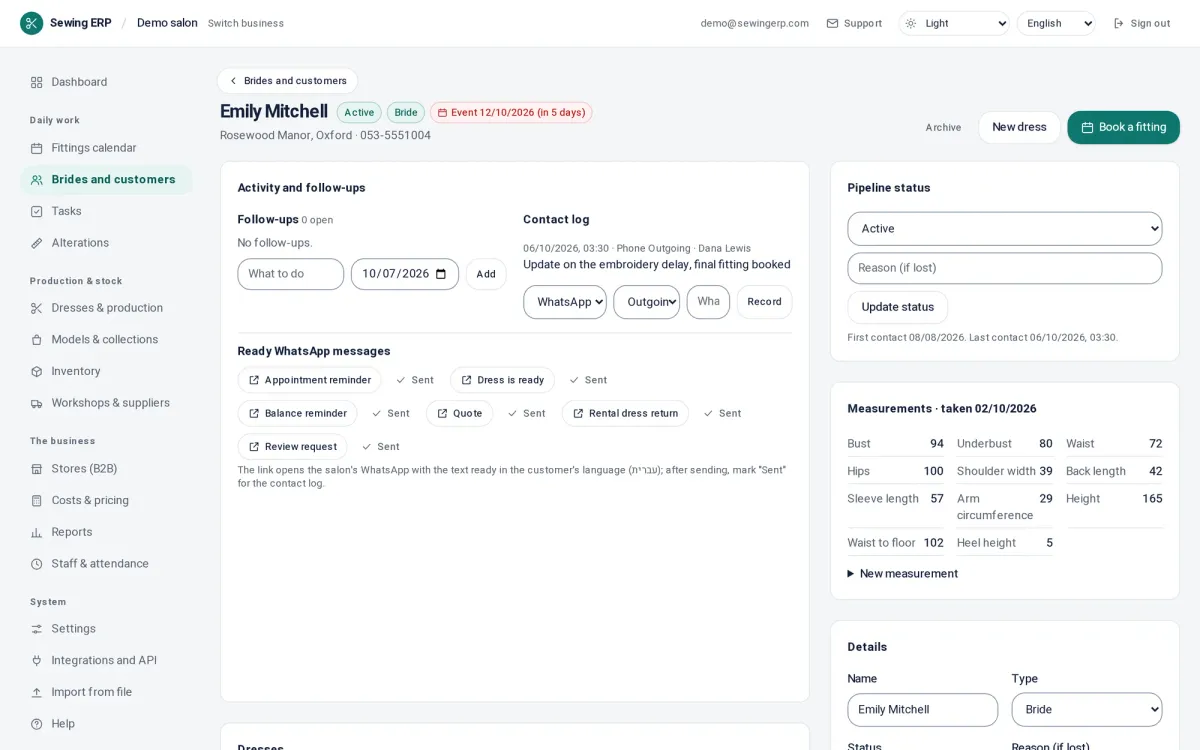
- Measurements with a date and a name. Every measuring is saved as a new version with its date and the staff member who took it (the one you pick, or the staff member of the fitting), and the bride's card shows the versions side by side.
- Digital signatures on your agreement or on her latest measurements, on a tablet in the shop or by link. The signed document is frozen: it records the name she typed, the time, whether it was signed in the shop or remotely, the IP address and the browser, and carries a verification code (a SHA-256 hash of the content). A signed document cannot be edited. Signatures are off until you turn them on.
- Who did what in the workroom. Each stage reported from the phone or the app is logged with the staff member and the time.
- An audit log of who changed what on a card, a payment or a document, and when. Owners and admins see it in the settings.
- Photos and files attached to the bride's card or to the dress.
- A full export of your data (a ZIP of CSV files) that owners and admins can download at any time.
When a bride asks who changed the measurements, there is an answer.
Not legal advice. The wording of your agreement is yours and your lawyer's: SewingERP stores and signs the text you write, it does not draft clauses.
Questions
Does a bridal shop need a written agreement?
It is the cheapest protection a shop has. When a dress is disputed, the first question is what was agreed and when, and a short agreement signed at the sale answers it: the price, what it includes, the payment dates, and what happens on cancellation or on big changes. Consumer and deposit rules differ by country, so have a local lawyer check the wording once; this guide is not legal advice.
What should a bridal shop record at each fitting?
The date, the measurements taken and who took them, what was changed or decided and at whose request, and photos of anything pinned or marked. Ask the bride to approve the measurements she was measured at, ideally with a signature.
What if the bride asks for a change after the work has started?
Write it down the same day: what she asked for, when, and what it changes in the price or the delivery date, and have her confirm it in writing. Most disputes start from a change that was only agreed out loud.
Should a bride sign at pickup?
Yes. A signature at pickup, after she has tried the dress on and you have gone through it together, records that she received it as agreed. Do the final check with a written list before she arrives, so nothing is left to memory.